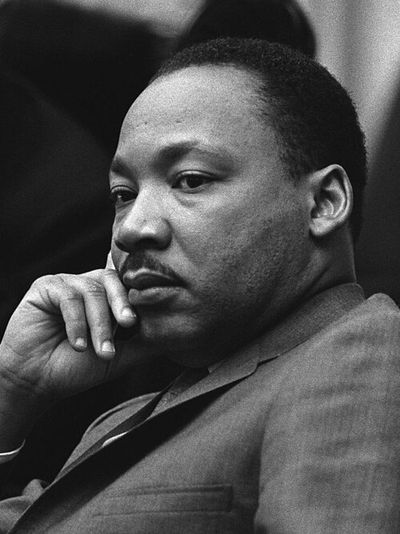
The exact words
What King meant in 1963
In the spring of 1963 King and the Southern Christian Leadership Conference joined local activists in Birmingham, Alabama, one of the most segregated cities in the country, for a campaign of sit-ins and marches. On Good Friday, April 12, he was arrested for defying a court order against the demonstrations. The same day, eight white clergymen published a statement calling the protests “unwise and untimely” and blaming them on “outsiders coming in.”
King’s letter is his reply, and this passage answers the charge of being an outsider head-on. He had been invited by local leaders, he explained, but more fundamentally he could not “sit idly by in Atlanta and not be concerned about what happens in Birmingham.” Injustice anywhere threatens justice everywhere because communities are bound together in “an inescapable network of mutuality.” If segregation could stand in Birmingham, rights were less secure in every other city too.
How the letter was written
King began the letter in the margins of a newspaper that carried the clergymen’s statement, continued on scraps of paper, and passed the pages to his lawyers and visitors, who carried them out to be typed. It is long, carefully argued and full of references to the Bible, Socrates, Augustine and Thomas Aquinas, written for an audience of educated moderates who sympathized with civil rights but disliked protest. The letter circulated widely in 1963 and was published in his book Why We Can’t Wait the following year.
How people use it today
The line is quoted in debates about human rights, international law and solidarity with people far away. That is a natural extension of King’s argument, which was itself about refusing to treat distance as an excuse. What gives the original its force is that King was answering a specific accusation from a jail cell, and turning the idea of “outsider” inside out: when justice is at stake, there are no outsiders.
What people get wrong
A general saying that everyone should care about unfairness somewhere far away.
A specific reply to the charge that King was an outsider in Birmingham. He argued that segregation anywhere harmed everyone, so no American was an outsider to it.
Timeline
- April 12, 1963King is arrested in Birmingham for marching in defiance of a court injunction against the protests.
- April 12, 1963Eight white Alabama clergymen publish “A Call for Unity,” criticizing the demonstrations as “unwise and untimely.”
- April 16, 1963King writes his reply from his cell, at first in the margins of a newspaper and on scraps of paper smuggled out by visitors.
- 1964The letter is published in King's book Why We Can't Wait and becomes one of the most widely read documents of the civil rights movement.
Use it in a speech
Questions people ask
Where does “injustice anywhere is a threat to justice everywhere” come from?
From Martin Luther King Jr.'s Letter from Birmingham Jail, dated April 16, 1963, written while he was jailed for leading protests against segregation.
Who was the letter written to?
It answered “A Call for Unity,” a public statement by eight white Alabama clergymen who called the Birmingham protests unwise and untimely and described King as an outsider.
What comes after the quote?
“We are caught in an inescapable network of mutuality, tied in a single garment of destiny. Whatever affects one directly, affects all indirectly.”
Cite this quote
These cite the original source directly, so you can use them in an essay or paper. Always check your teacher's required style.
Sources
- Martin Luther King Jr., Letter from Birmingham Jail, April 16, 1963. The Martin Luther King, Jr. Research and Education Institute, Stanford University.
- Martin Luther King Jr., Why We Can't Wait (1964).
- “A Call for Unity,” statement by eight Alabama clergymen, April 12, 1963.