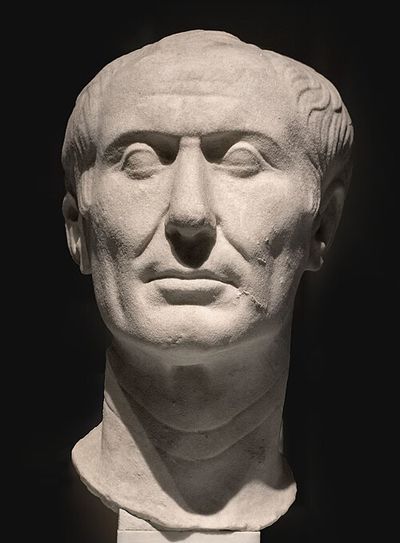
The exact words
“Iacta alea est, inquit.”Suetonius, Life of the Deified Julius 32 (“‘The die is cast,’ he said”). Plutarch, Life of Pompey 60, says Caesar spoke the words in Greek.
≈ ParaphraseThe idea is genuine, but the popular wording is not what was actually said or written.
What people get wrong
Common reading
“The die is cast” means fate has already decided everything.
“The die is cast” means fate has already decided everything.
Closer to the original
Caesar was making a choice, not giving in to fate. The image is of a gambler who has thrown and now has to live with the roll.
Caesar was making a choice, not giving in to fate. The image is of a gambler who has thrown and now has to live with the roll.
Timeline
- January 49 BCCaesar leads an army across the Rubicon, the border of his province. Bringing troops into Italy is an act of war against the Senate, and civil war follows.
- c. AD 100Plutarch writes that Caesar said the words in Greek, as a familiar proverb from Greek comedy, the kind of thing people said before a bold gamble.
- c. AD 121Suetonius gives the Latin version, “iacta alea est,” which over time is rearranged into the familiar “alea iacta est.”
- Today“Crossing the Rubicon” and “the die is cast” both mean passing a point of no return.
Use it in a speech
When Caesar crossed the Rubicon he reportedly said, “the die is cast.” For our town, the decision to close the old mill was that kind of moment.
~9 secondsto say aloud
Pausenone needed in writing
Best spotopening sentence
When Caesar crossed the Rubicon, he said the die is cast. We've signed up, we've trained, there's no turning back now. Let's go and make the roll count.
~10 secondsto say aloud
Pauseafter “the die is cast”
Best spotthe last minute before kickoff
Questions people ask
What does alea iacta est mean?
“The die has been cast.” A die is one of a pair of dice, so it means the throw has been made and cannot be undone.
Did Caesar really say alea iacta est?
Suetonius reports him saying “iacta alea est.” Plutarch says he said it in Greek, quoting a well-known proverb. So the idea is well attested, but the exact Latin word order is a later tidy-up, and the original words may not have been Latin at all.
What does crossing the Rubicon mean?
Taking a step from which there is no going back. It refers to the same moment in 49 BC.
How do you pronounce it?
Roughly “AH-lay-ah YAK-tah est.”
Cite this quote
These cite the original text directly, so you can use them in an essay or paper. Always check your teacher's required style.
MLACaesar, Julius. Words spoken while crossing the Rubicon, recorded by Suetonius and Plutarch. January 49 BC. The Latin Library, www.thelatinlibrary.com/suetonius/suet.caesar.html.
APACaesar, J. (49 B.C.E.). Words spoken while crossing the Rubicon, recorded by Suetonius and Plutarch. The Latin Library. https://www.thelatinlibrary.com/suetonius/suet.caesar.html
CHICAGOJulius Caesar, Words spoken while crossing the Rubicon, recorded by Suetonius and Plutarch, January 49 BC.
IN TEXT (APA)(Caesar)