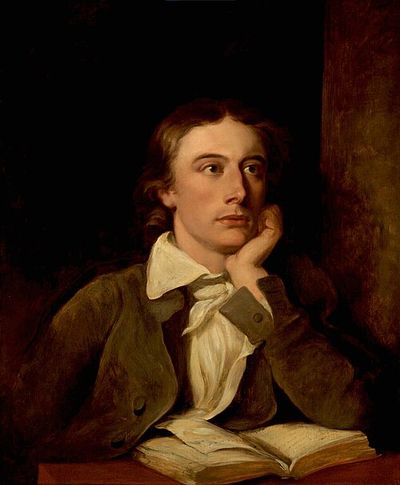
The exact words
“When old age shall this generation waste, Thou shalt remain, in midst of other woe Than ours, a friend to man, to whom thou say'st, “Beauty is truth, truth beauty,”—that is all Ye know on earth, and all ye need to know.”John Keats, Ode on a Grecian Urn, lines 46–50, in Lamia, Isabella, The Eve of St. Agnes, and Other Poems (1820)
✓ VerifiedFound in a primary source: the original book, speech transcript, letter or recording.
What people get wrong
Common reading
Keats's personal motto, stated plainly.
Keats's personal motto, stated plainly.
Closer to the original
The words are spoken by the urn, and the poem has just spent four stanzas showing that the urn's world is beautiful partly because it is frozen and not real. Many readers hear the ending as the urn's message, offered with some irony, rather than Keats's own creed.
The words are spoken by the urn, and the poem has just spent four stanzas showing that the urn's world is beautiful partly because it is frozen and not real. Many readers hear the ending as the urn's message, offered with some irony, rather than Keats's own creed.
Timeline
- May 1819Keats, 23 and already ill, writes a series of great odes in a few weeks in Hampstead, including the Ode on a Grecian Urn. The poem looks at the carved figures on an ancient vase, frozen forever in a moment of chase and music.
- January 1820The ode first appears in the magazine Annals of the Fine Arts, without quotation marks around the famous line. In the 1820 book, only “Beauty is truth, truth beauty” is put in quotation marks, which starts the long argument about who says the rest.
- 1821Keats dies of tuberculosis in Rome, aged 25.
- 1900sCritics such as T. S. Eliot and Cleanth Brooks argue over whether the ending is profound or empty, and over who says “that is all ye know”: the urn, the poet, or the poet to the reader.
Use it in a speech
Keats gives his famous equation, “Beauty is truth, truth beauty,” not to the poet but to a silent marble urn, which makes the claim as puzzling as it is memorable.
~9 secondsto say aloud
Pausenone needed in writing
Best spotthesis sentence
Keats wrote that beauty is truth, and truth beauty. Looking at the two of you today, I finally understand what he meant.
~7 secondsto say aloud
Pauseafter “truth beauty”
Best spotthe closing compliment
Questions people ask
Who says “Beauty is truth, truth beauty”?
In the poem, the Grecian urn says it. The words that follow, “that is all ye know on earth,” may be the urn, the poet, or the poet speaking to us. Scholars disagree.
When was Ode on a Grecian Urn written?
In May 1819. It was published in 1820.
Cite this quote
These cite the original source directly, so you can use them in an essay or paper. Always check your teacher's required style.
MLAKeats, John. “Ode on a Grecian Urn.” 1819. Project Gutenberg, www.gutenberg.org/ebooks/23684.
APAKeats, J. (1819). Ode on a Grecian Urn. Project Gutenberg. https://www.gutenberg.org/ebooks/23684
CHICAGOJohn Keats, “Ode on a Grecian Urn,” 1819.
IN TEXT (APA)(Keats, 1819)