The exact words
What happened in 1776
In September 1776 the Continental Army had been driven off Long Island and George Washington badly needed to know where the British would strike next. Nathan Hale, a captain in an elite ranger unit and a former schoolteacher, volunteered to cross behind enemy lines disguised as a teacher. He was captured within days, and on September 22 he was hanged in Manhattan without a trial, as was normal for spies.
A British officer, Captain John Montresor, was present at the execution. Later that day he came to the American lines under a flag of truce and told officers, including Hale’s friend William Hull, that Hale had died with great composure and had made a brave final speech. Hull’s account of what Montresor reported, with the famous sentence, was published in his memoirs in 1848.
Was he quoting a play?
The line sounds strikingly like a passage in Joseph Addison’s Cato, a 1713 tragedy about a Roman statesman who chooses death over tyranny. The play was enormously popular in the colonies; George Washington had it performed for his troops at Valley Forge. In it a character says: “What pity is it / That we can die but once to serve our country!” Hale was educated at Yale and would almost certainly have known the play, so it is quite possible he consciously echoed it, much as a modern speaker might borrow a line from a famous film.
How to quote it
Credit the line to Nathan Hale, as everyone does, but treat it as the words witnesses remembered rather than a precise record. In formal writing, a short note that the wording comes from later recollections, and that it echoes Addison’s Cato, makes your use of it more accurate and more interesting.
What people get wrong
Words written down on the spot as Hale stood on the gallows.
Words remembered and passed along by witnesses, first published in this form about seventy years later. Hale probably said something close, possibly echoing a play he knew.
Timeline
- 1713Joseph Addison's play Cato, hugely popular in colonial America, includes the line: “What pity is it / That we can die but once to serve our country!”
- September 22, 1776Hale is hanged as a spy by the British in Manhattan without a trial. A British officer, John Montresor, later describes his calm last moments to Americans.
- 1848The memoirs of William Hull, Hale's friend and fellow officer, are published with the now-famous wording, based on Montresor's account.
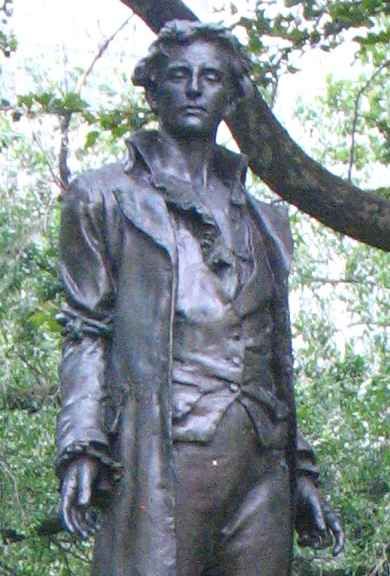
- TodayThe line is carved on statues of Hale and is the official motto of countless patriotic speeches.
Use it in a speech
Questions people ask
Did Nathan Hale really say “I only regret that I have but one life to lose for my country”?
Probably something close to it. The words come from the account of a British officer, John Montresor, passed on to Hale's friend William Hull, whose memoirs with this wording were published in 1848. Some early reports give different last words.
Where does the line come from?
It closely echoes Joseph Addison's 1713 play Cato, which was widely read and performed in colonial America. Hale, a Yale graduate and teacher, would very likely have known it.
How old was Nathan Hale when he died?
He was 21, executed on September 22, 1776.
Cite this quote
These cite the original source directly, so you can use them in an essay or paper. Always check your teacher's required style.
Sources
- Memoirs of the Campaign of the North Western Army... by General William Hull, and Revolutionary Services of Captain Nathan Hale (1848).
- Joseph Addison, Cato, a Tragedy (1713), Act 4. Project Gutenberg.
- Connecticut Historical Society and Yale University Library, Nathan Hale collections.