The exact words
What Armstrong meant
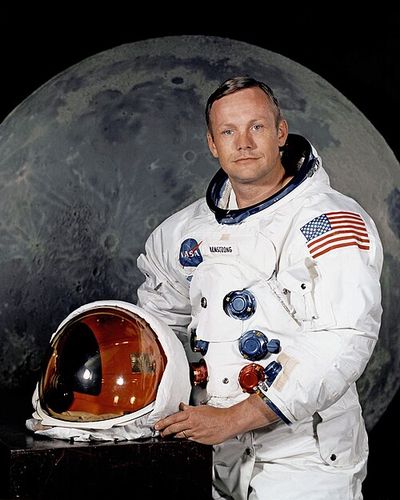
On July 20, 1969, the lunar module Eagle landed on the Moon’s Sea of Tranquility with Neil Armstrong and Buzz Aldrin aboard. Several hours later Armstrong climbed down the ladder and, as his boot touched the surface, spoke the sentence that has been quoted ever since. Hundreds of millions of people around the world were watching or listening live.
The meaning is in the contrast. The step itself was small, just one man stepping off a ladder, but what it represented for humanity was enormous. That contrast only works if the first half says “a man,” meaning one person. Without the “a,” “man” and “mankind” both mean humanity, and the sentence technically contradicts itself.
The missing “a”
Listeners have argued for decades about whether Armstrong said “a.” On the recording it is not audible, and Armstrong himself admitted he could not hear it either. He always said he had intended it and suggested it was lost in the transmission or swallowed in his speech. NASA’s official transcript prints it in brackets. In 2006 an Australian computer programmer analyzed the recording and claimed to find a brief sound where the “a” should be; other audio experts were not persuaded. The honest answer is that we cannot be sure what was said, but we know what was meant.
Was it scripted?
Many people assumed NASA had written the line. Armstrong said he had thought of it himself, mostly after the landing, in the hours before he went outside, and his biographer found no evidence of a NASA script. Its simplicity fits his character: a quiet engineer who did not enjoy speeches.
How people use it today
The line is used for any first step that starts something larger: a first job, a new company, a graduation. When you quote it, include the “a” in brackets or say “one small step for a man”; it is what Armstrong intended, and it makes the sentence work.
What people get wrong
The line was carefully scripted for Armstrong by NASA.
Armstrong said he thought of it himself during the mission. He meant “one small step for a man,” so the sentence was about one person's step and humanity's leap.
Timeline
- July 16, 1969Apollo 11 launches from Kennedy Space Center in Florida.
- July 20, 1969The lunar module Eagle lands, and hours later Armstrong steps onto the surface and speaks the line, heard live by hundreds of millions of people.
- After 1969Armstrong says he intended to say “for a man” and that the word may have been lost in transmission.
- 2006A computer analysis of the recording claims to find a trace of the “a”; other experts are not convinced.
Use it in a speech
Questions people ask
What exactly did Neil Armstrong say on the Moon?
The recording sounds like “That's one small step for man, one giant leap for mankind.” Armstrong said he intended “one small step for a man,” and NASA's transcript shows the word in brackets: “for [a] man.”
Why does the missing “a” matter?
Without it, “man” and “mankind” mean the same thing, so the sentence does not quite make sense. With it, the contrast is between one person's step and a leap for humanity.
Did NASA write the line?
Armstrong said he came up with it himself, thinking about it after the landing and before he left the lunar module.
Cite this quote
These cite the original source directly, so you can use them in an essay or paper. Always check your teacher's required style.
Sources
- Apollo 11 Lunar Surface Journal, NASA.
- NASA, Apollo 11 mission overview.
- James R. Hansen, First Man: The Life of Neil A. Armstrong (2005).